Cities of the Dead, Part II
I’m not a religious person — today, I happily identify as an agnostic existentialist — but I was raised in the Roman Catholic tradition. I suppose that accounts for my predilection toward idolatry, shrines, and the pomp and circumstance surrounding ceremonies — and my lingering Catholic Guilt.
Although I have not attended Mass since my confirmation, I still bow my head (OK, sometimes I just think about bowing my head but whatever it still counts) whenever I hear “Jesus.” Despite the fact I know it’s just some plastic beads melted onto a string in China, I cannot bring myself to throw away the Rosary I received in first grade in Catholic school (I’m not alone, this is totally a thing). And I am not ashamed to admit I still occasionally pray to the Blessed Virgin Mary when I really need a hand, and am planning some type of sanctuary of honor (idk what you call these things when you’re not into religion) for her that will most definitely include some of those awesome supermarket candles with her face on them.
I guess that past is what made it so easy for me to jump on the bandwagon of one of New Orleans’ most popular legends: asking voodoo queen Marie Laveau for help in life, more than 100 years after her death.
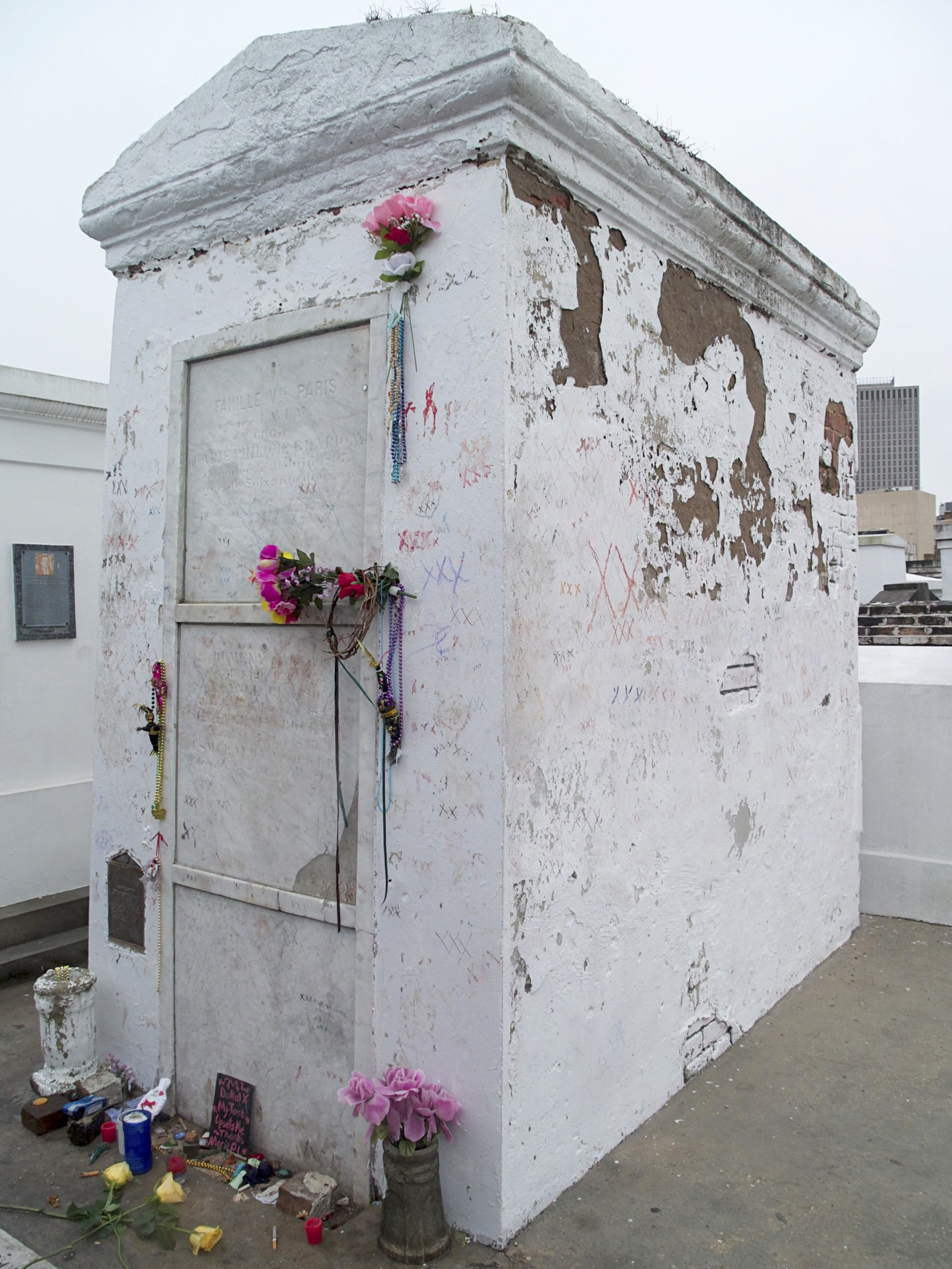
The likely final resting place of Marie Laveau — and one of the most-visited tombs in the United States. *
But, more on Ms. Laveau later. First, I want to touch upon a few of the other notables buried in Saint Louis No. 1.
Fame in Life, & in Death
When we last left off, we had discussed the history of burial rights in the Big Easy, as well as the types of tombs commonly found in the Cities of the Dead – the cemeteries. Saint Louis No. 1, the oldest of the city’s cemeteries, unsurprisingly has a host of famous residents and tombs.
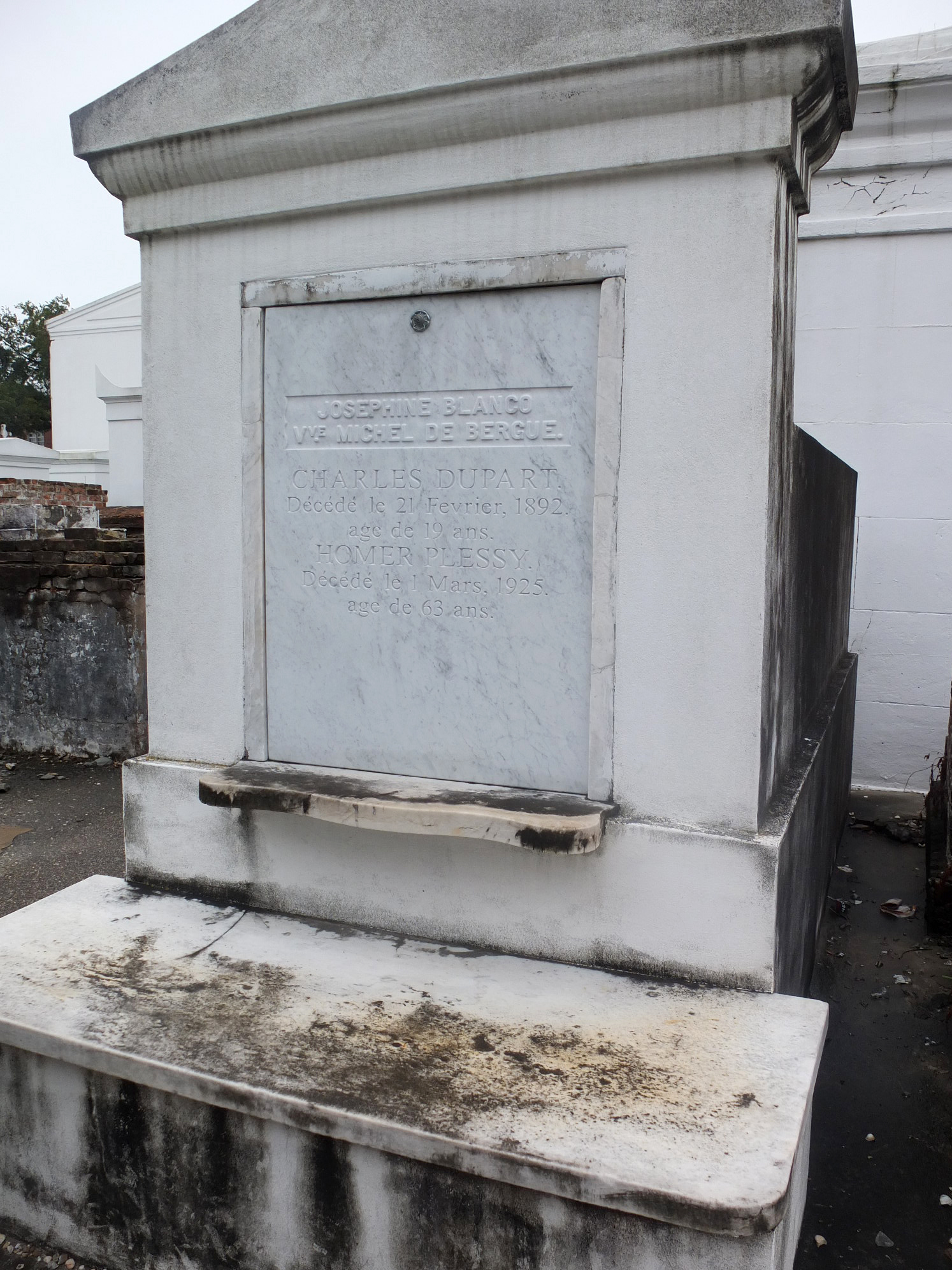
Homer Plessy is buried here. *
Homer Plessy’s final resting place is in Saint Louis No. 1. In life, Plessy (1862-1925) was the plaintiff in the famous Plessy v. Ferguson Supreme Court case. According to the Louisiana Historical Association, he was born seven-eighths white, and one-eighth black. In 1892, he purchased a railroad ticket for first class in Louisiana; after he took an open seat in a car reserved for white passengers and refused to leave, he was arrested.
At the time, his actions were in violation of a state statute that segregated travel accommodations, leading to his arrest. Plessy, however, said the law was violating his rights under the Thirteenth Amendment (the amendment that abolished slavery) and the Fourteenth Amendment (one of the most frequently legally challenged amendments, this addresses citizenship rights and equal protection). He petitioned the Louisiana Supreme Court to prevent a trial from being held by Judge John H. Ferguson.
The Supreme Court found the statute Plessy was arrested under did not violate the amendments (but go Judge John M. Harlan, who dissented!), and the landmark case formed the basis of racially segregated school systems until Brown v. Board of Education overturned that in 1954.
Plessy is remembered as an integral part of the civil rights movement.
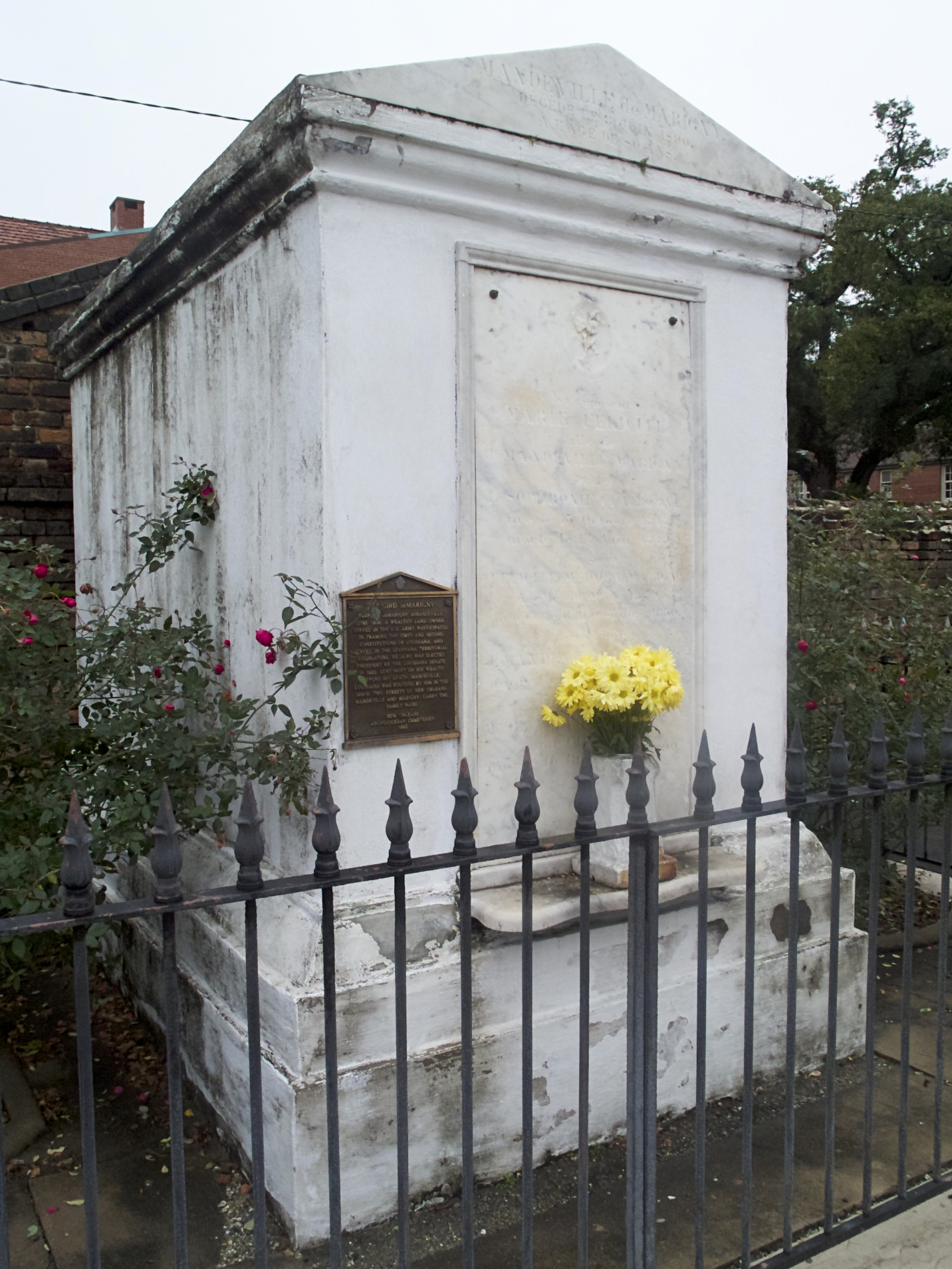
Is this the tomb of the man responsible for bringing craps to the U.S.? That’s for you to decide. *
Saint Louis No. 1 is also the final resting place of Bernard de Marigny, who may or may not have introduced the game of craps to America. He also has one of the most incorrectly told stories of anyone in the cemetery.
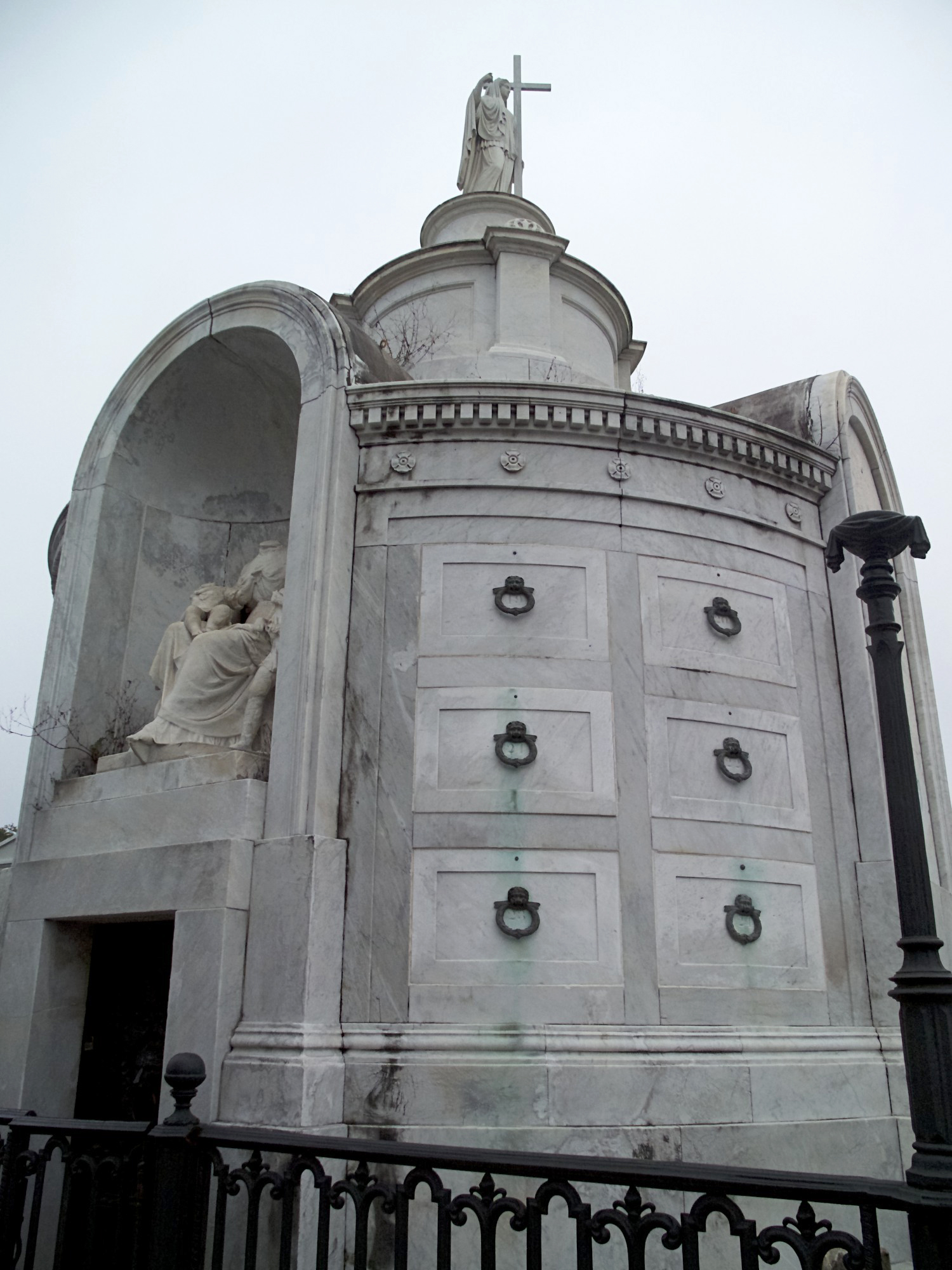
The Italian Society tomb is one of the larger tombs in Saint Louis No. 1. *
Never short on a good party story, even the tombs in NOLA don’t disappoint — the Italian Benevolent Society Tomb has its own storied history.
Aside from the rumor that the tomb itself was cursed (several of those associated with the tomb’s conception died prematurely), an iconic scene of Dennis Hopper’s film Easy Rider includes a close-up encounter with a statue on the tomb, filmed without permission.
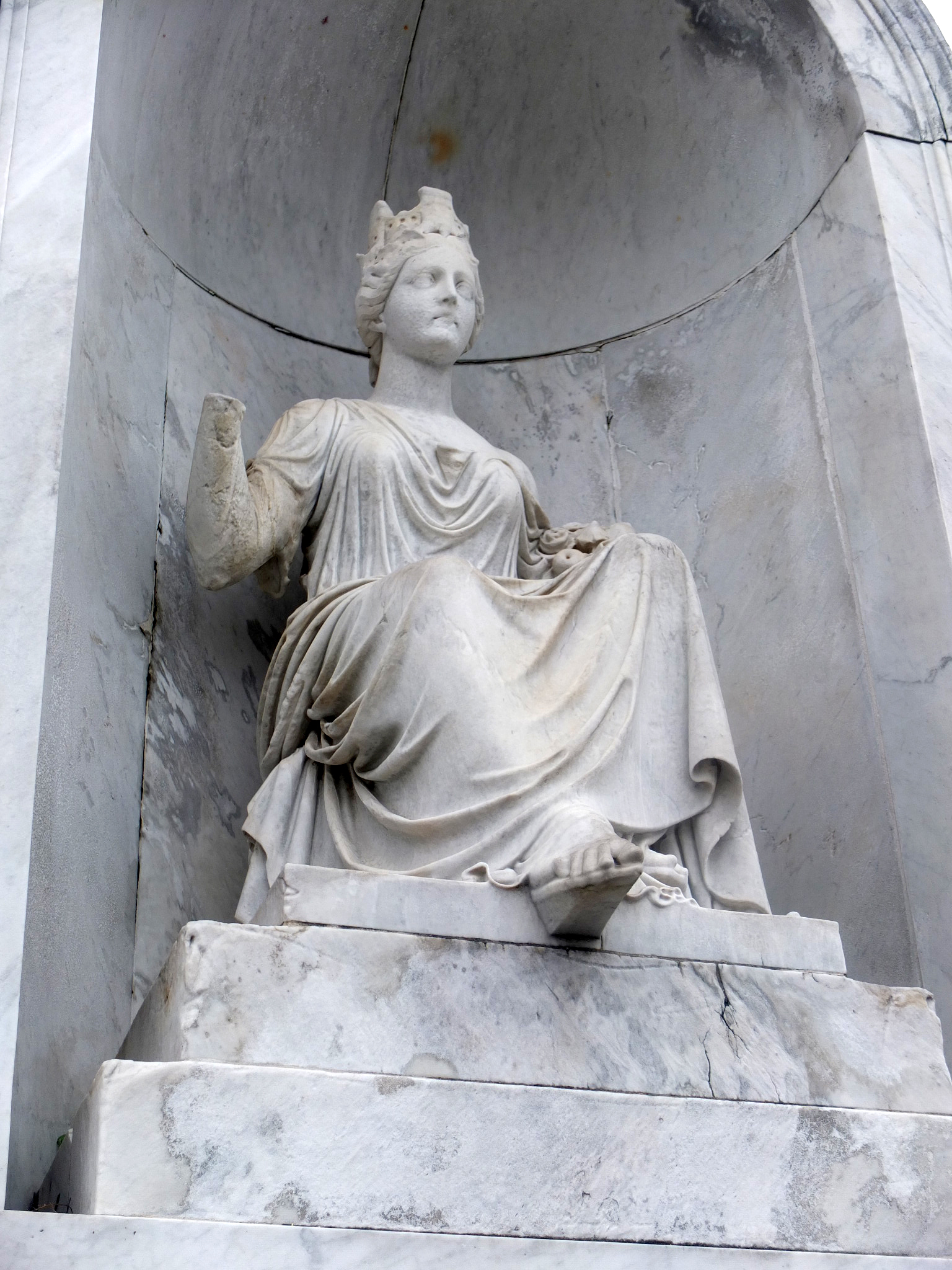
Check it out, it really is in the movie. *
After Easy Rider, the diocese put an outright ban on any filming in its cemeteries (though there are other cemeteries in the city that are not diocese-owned where filming has occurred, like Lafayette Cemetery No. 1 in the Garden District).
Now, it wouldn’t be New Orleans without a little bit of mysticism of some sort; yes, I’m talking about voodoo. Marie Laveau is not the only practitioner of the religion who has found a permanent home within the walls of Saint Louis No. 1.
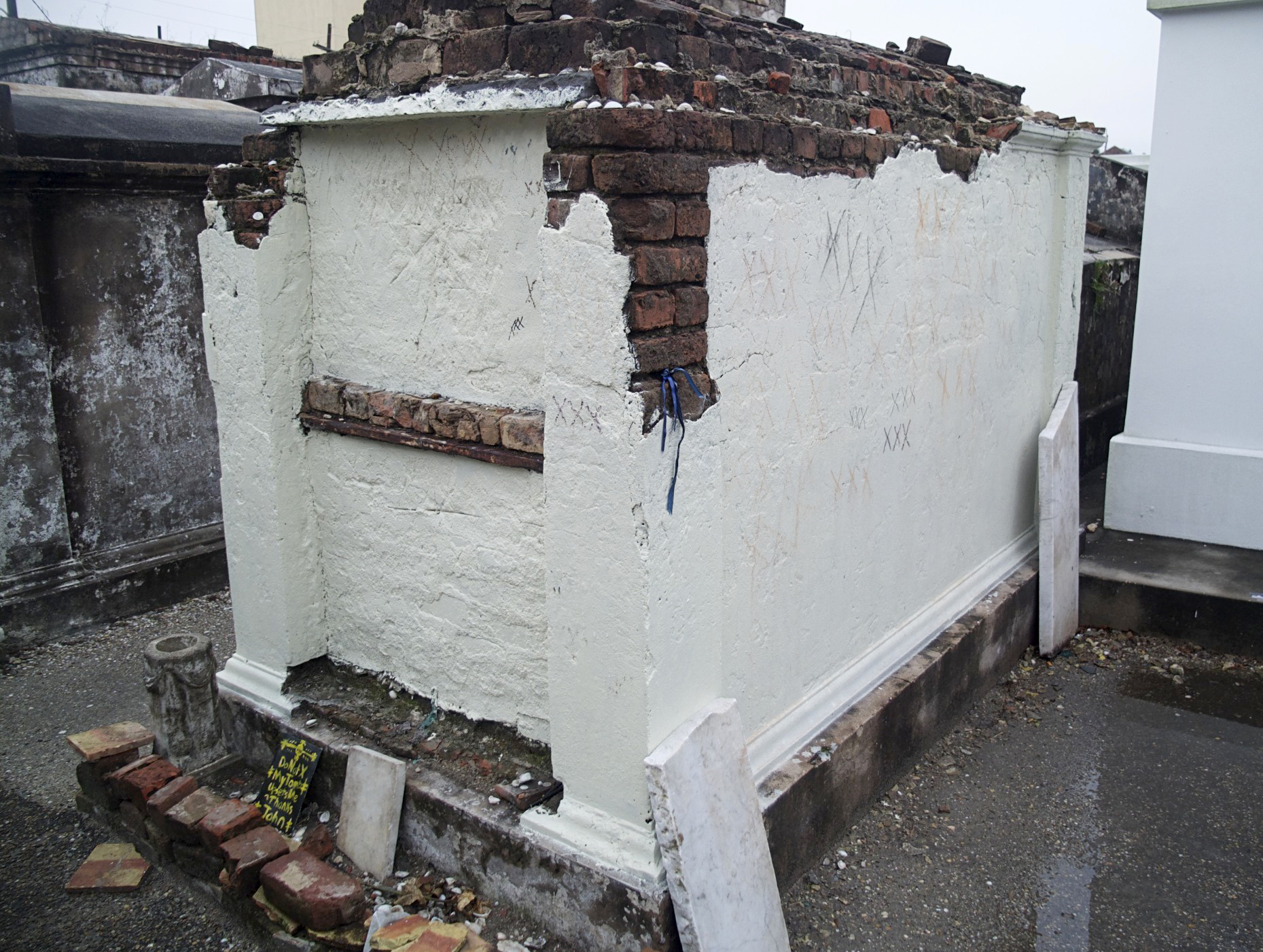
I believe this is the tomb of John Montenet, the voodoo king. *
You’ll notice the tomb in the photo above prominently features multiple XXX markings, which are common among tombs that hold practitioners of voodoo. While I’m not 100-percent sure, I believe this is the tomb of John Montenet — or, Doctor John, the voodoo king.
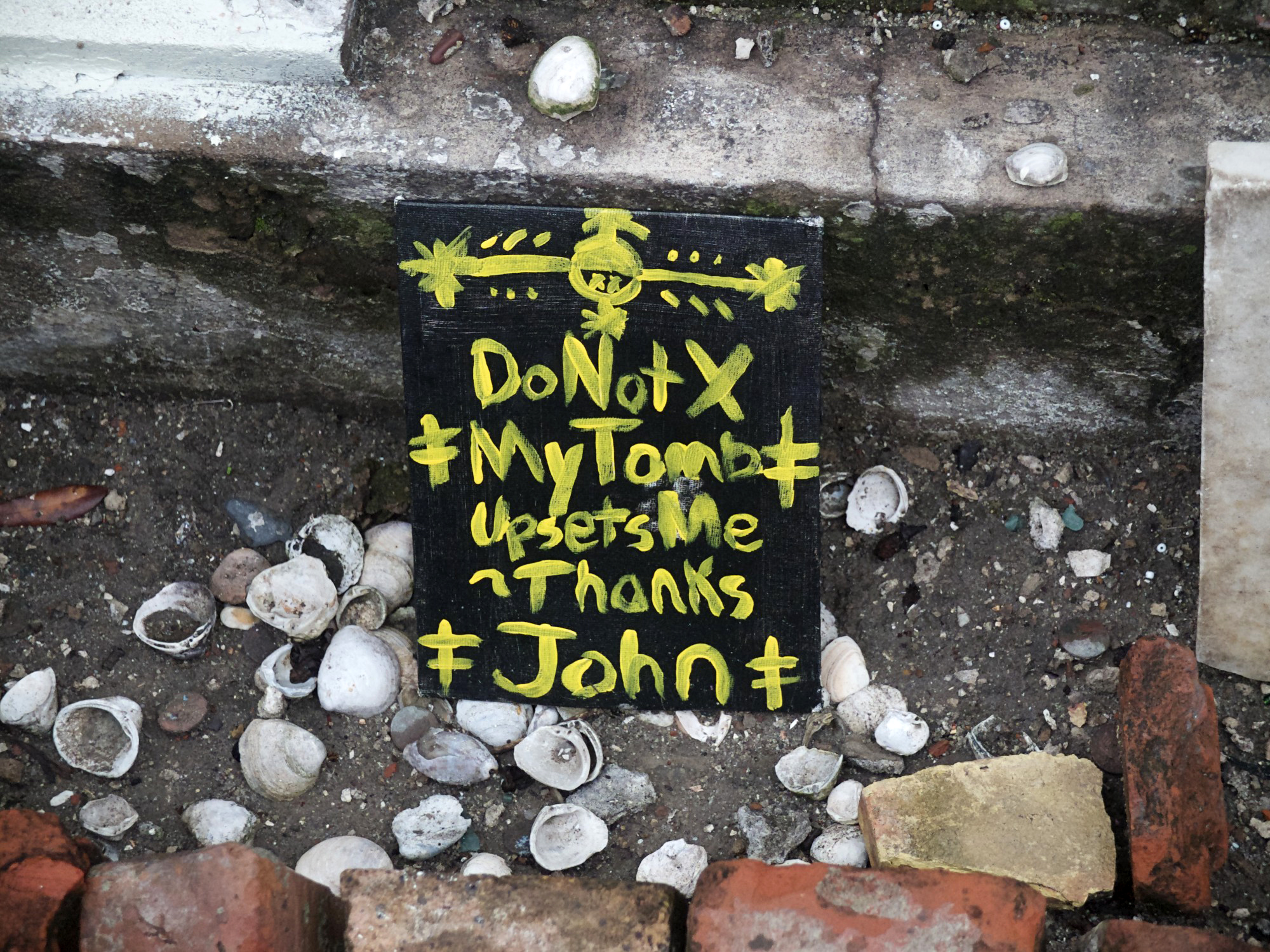
Really, the Xs are just desecration here, folks. *
The triple-X marking is part of a ritual in asking a deceased practitioner of voodoo for help with some aspect of one’s life, or a favor. The ritual involves knocking on the tomb, spinning around, leaving an offering … it seems fairly complicated, but it is also, simply put, desecration.
And desecration of a tomb is especially important when it comes to the next, and last, famous resident of Saint Louis No. 1 that I will touch upon today — Ms. Laveau herself.

This flower is pink, but the tomb no longer is; someone recently vandalized Ms. Laveau’s tomb by painting it a rosy hue. *
Little is known today about the living Ms. Laveau, but her fame in death is certainly derivative of her fame in life. Today, she is called the Voodoo Queen of New Orleans — a title that she also held in life, in the 1800s. She was born a free woman of color in 1801, and in 1819, she married Jacques Paris. They had two children, both of whom died young, it is believed. Paris died within a few years.
Ms. Laveau went on to enter into a plaçage with Louis Christophe Dominick Duminy de Glapion. A plaçage was a type of common-law marriage that allowed white men to “marry” women of color, if not legally, then in conscience. The plaçage was entered via a contract of some sort, and was commonly practiced in New Orleans. Ms. Laveau and de Glapion had seven children, two of whom survived to maturity. One of those children, a daughter — Marie Laveau II — allegedly took her mother’s place as the reigning voodoo queen in the 1870s. Ms. Laveau, a Catholic, lived until 1881, and it is believed she was buried in the middle vault of the de Glapion family tomb in Saint Louis No. 1.
Little else is known about the life of Marie Laveau. She remains an enigma, with stories swirling about her memory that create a thick shroud of mystique. Her tomb has become one of the most visited in the country, and has often attracted followers that prefer asking for favors using the XXX method; it is positively covered with the markings. At least one of Ms. Laveau’s more devout followers has tried to remove the Xs, albeit in a nontraditional (and, as it turns out, rather harmful) way.
However, Renee — my tour guide through Saint Louis No. 1 — emphasized that marking anyone’s grave is desecration.
She offered another way to ask for Ms. Laveau’s guidance: simply place your hand on the side of her tomb, and ask for help. When she has granted your wish — whether outright, or by coming to you in a dream with the knowledge to help you achieve your end goal — return with an offering.
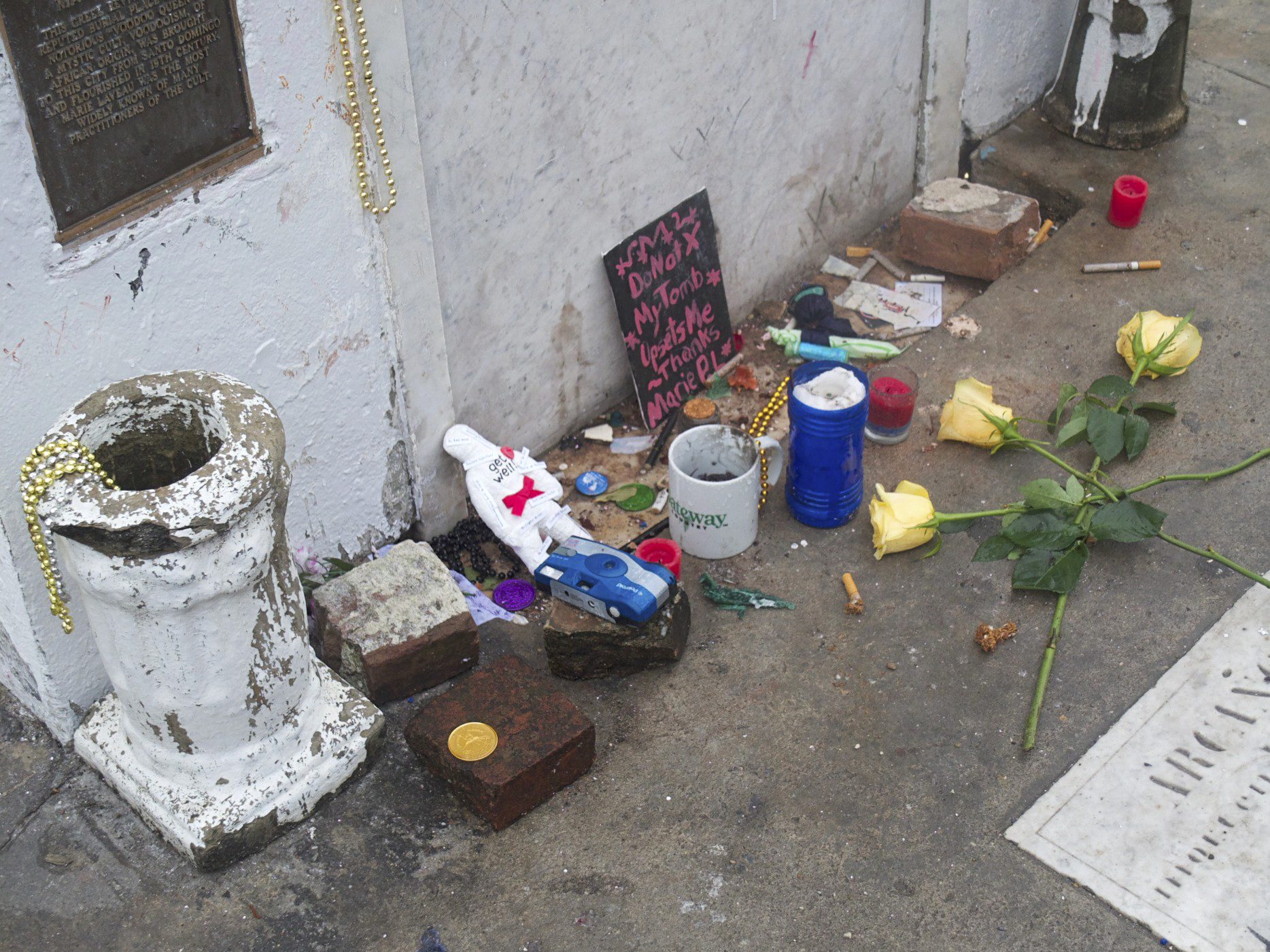
Offerings abound at the de Glapion family tomb. *
Naturally, I placed my hand on the cool brick of the tomb and, concentrating on getting my message to the voodoo queen herself, I made my wish.
I think this is kind of like when you make a wish on birthday candles or on a star — you can’t tell anyone what you wished for, or it won’t come true — so I’ll keep mum for the time being. But I will tell you, that night, I certainly had an odd, and oddly relevant, dream.
The State of the Cities
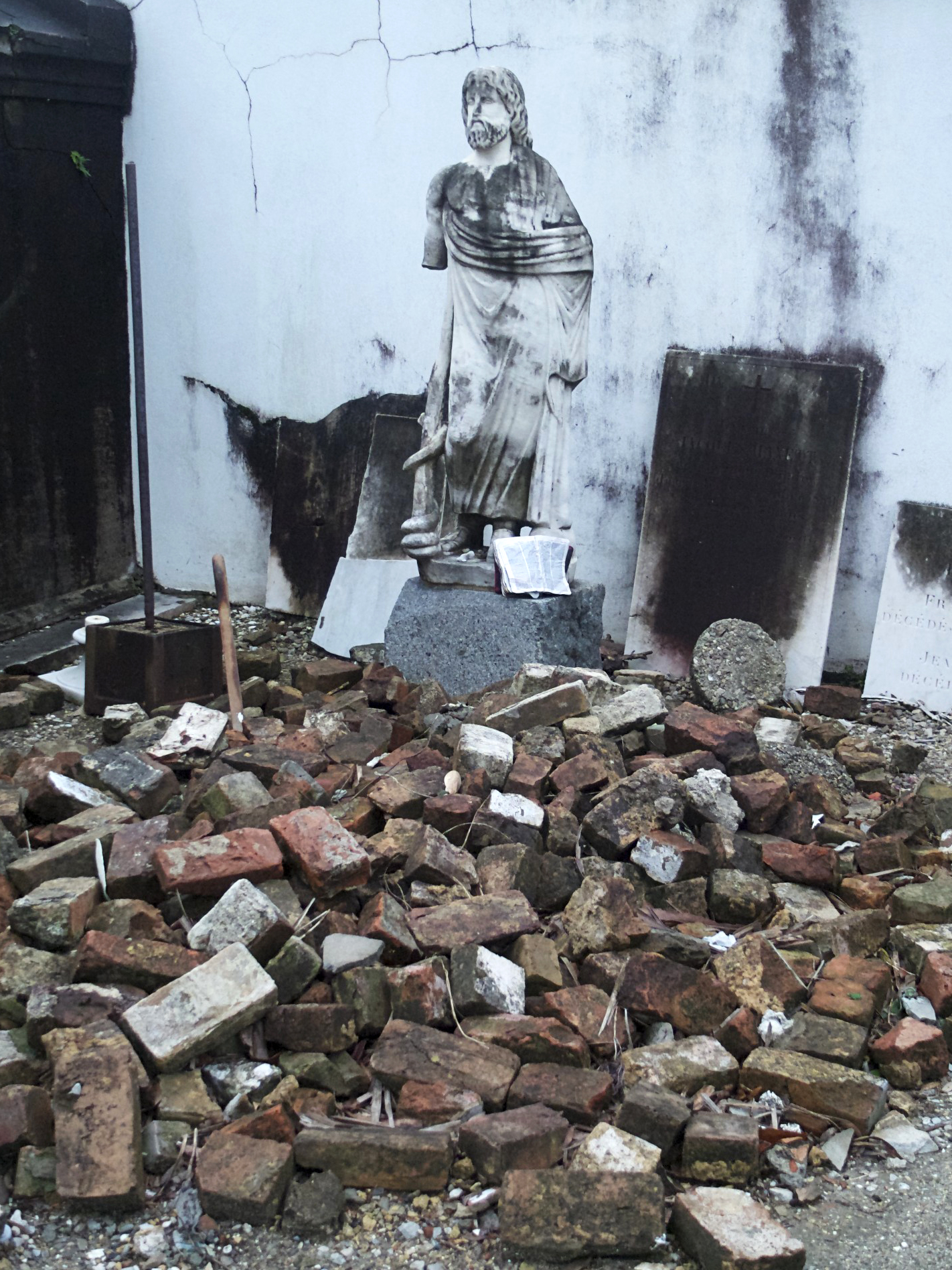
Not sure if this was once a tomb or is just a pile of rubble, but learning it was a tomb would not surprise me. *
If you walk around one of the older cemeteries in NOLA, particularly Saint Louis No. 1, you will notice tombs in all states of repair. Some are brand new, some look brand new and some are mere piles of rubble. Many of the older tombs are unclaimed.
Save Our Cemeteries is a group dedicated to the preservation of the Cities of the Dead and has spent millions repairing and stabilizing tombs throughout New Orleans.

An alley of restored tombs. *
For instance, Save Our Cemeteries organized the restoration of the tombs along this alley — all are an original color, and have been preserved in a way that allows the brick they are built out of to breathe. The proper way to care for an aging tomb is with a lime-based mortar and plaster, followed by a lime wash.
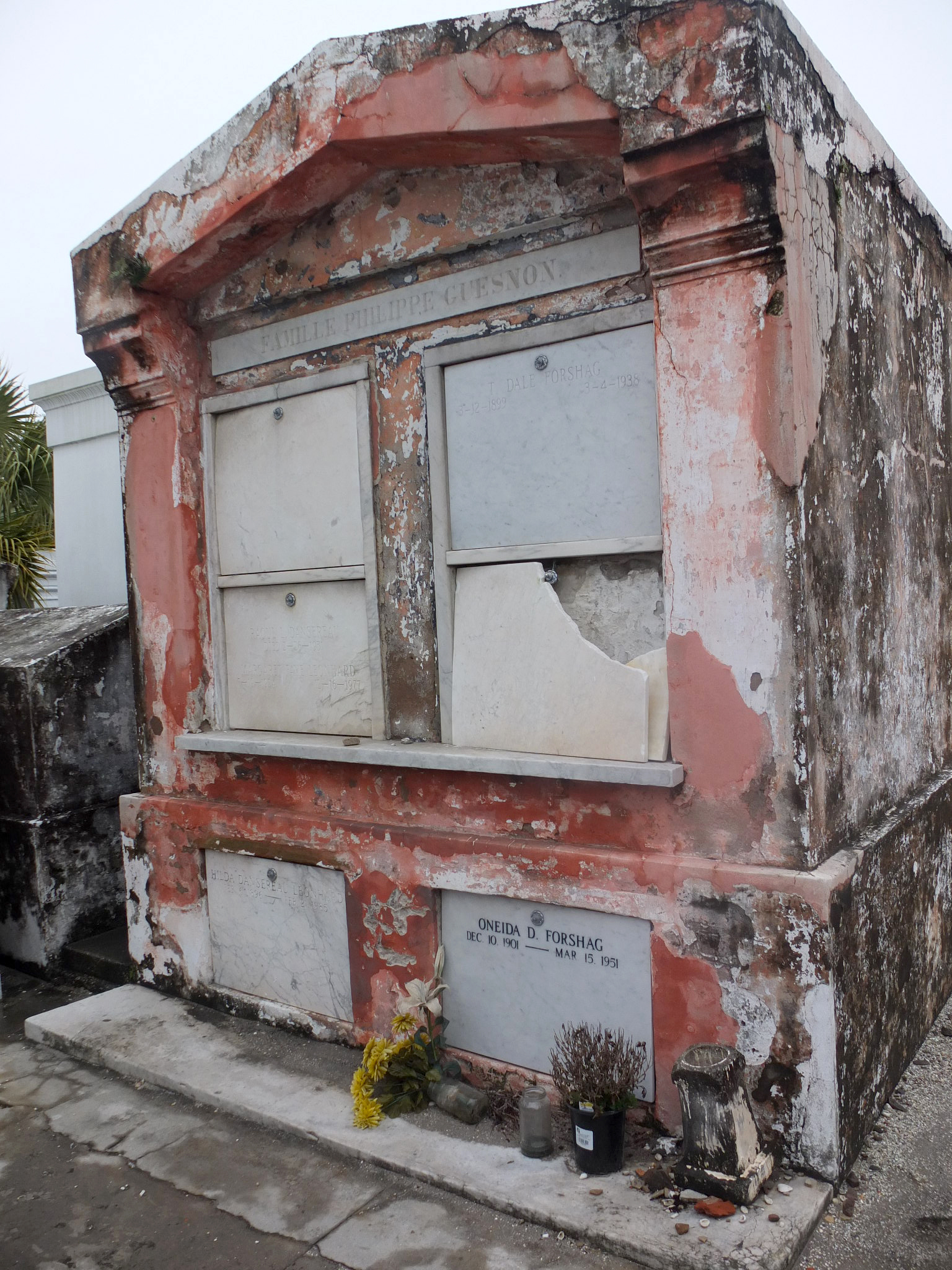
A restored family tomb. *
This is a tomb that a family began to restore with the help of Save Our Cemeteries (though the restoration has fallen by the wayside in recent years, likely an indication of the overall economy). While it may look as if its facade is unfinished, the family decided to leave the front of the tomb multiple colors — there is at least one family member that was laid to rest there for each color the tomb has been in the past.
The diocese, however, has a slightly different take on preservation. Instead of using the preferred lime-based treatments on older tombs, the diocese employs the more modern Portland cement to encase older, decaying structures.

The tomb to the left is a perpetual care tomb and has been encased in Portland cement. *
Aside from the fact that the character has ostensibly been stripped from those tombs, they look brand new — but they will run into trouble down the road. The new cement does not allowed the old brick-and-mortar structures to breathe properly, furthering their decay. It is likely that newly encased tombs will basically rot from the inside out.
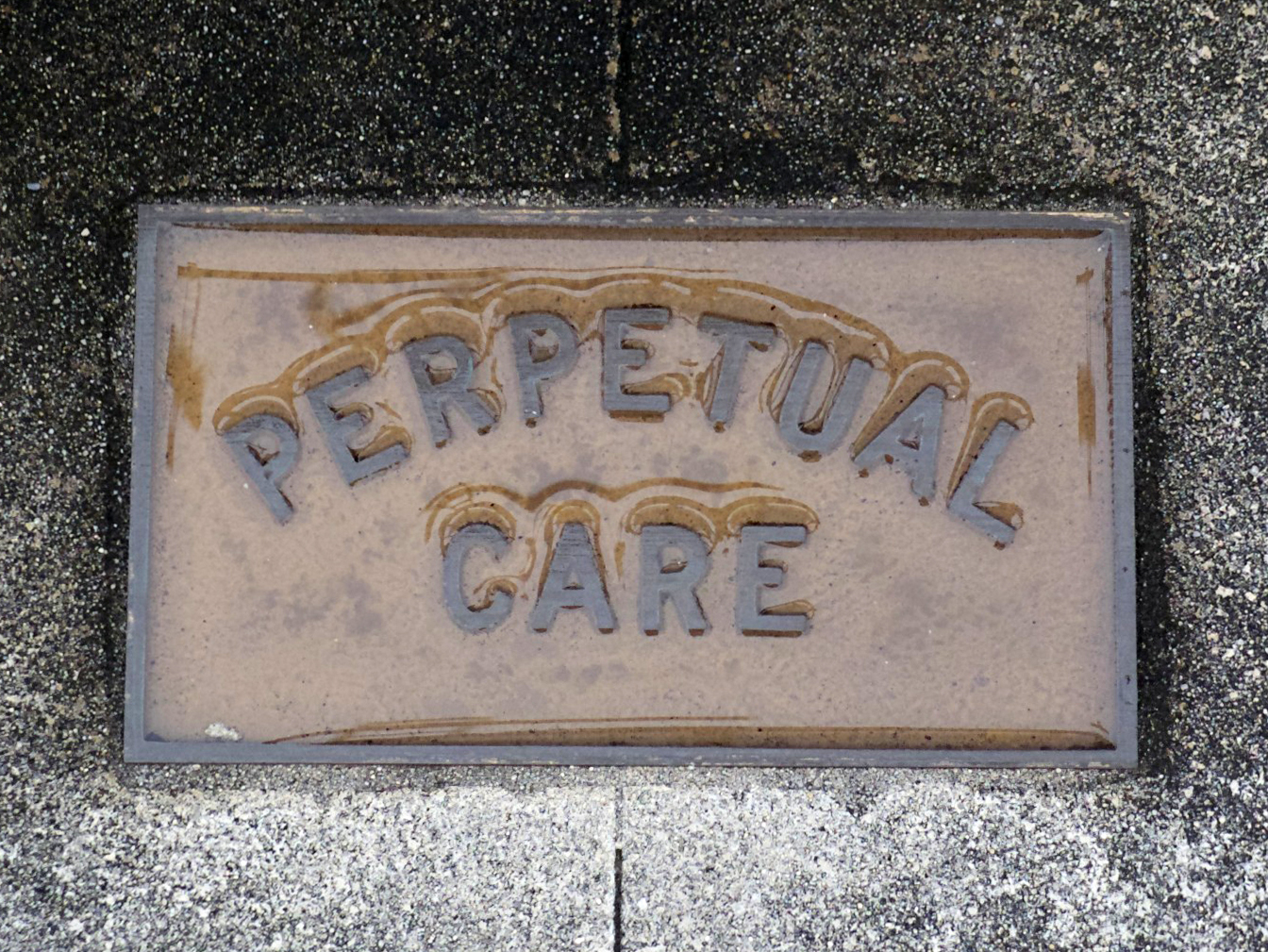
These plaques mark those tombs under the perpetual care of the diocese. +
The diocese also offers another option to families with tombs in the Cities of the Dead: for a set price, they will care for the tomb in perpetuity. (For older tombs, this does usually mean the Portland cement option, from what I could see; however, I noted many newer, marble tombs were also marked as perpetual care tombs.) Perpetual care tombs are just that — the owner of the cemetery (I’ve been using diocese here, but there are some cemeteries that are not owned by the diocese; I do not believe the city offers a perpetual care option, though) will upkeep the tomb in perpetuity, in exchange for a set fee from the owner of the tomb.
All new tombs in Catholic NOLA cemeteries have carried a mandatory perpetual care fee since the mid-1980s; the one-time fee is a few thousand dollars.

No matter its state of decay, if a tomb is still standing, it has a good shot at restoration. *
While the Portland cement tombs may be aesthetically cleaner and easier to maintain in the short-term, it’s the traditional brick-and-mortar tombs that connote the Cities of the Dead in my mind. And though they may show signs of decay, any tomb that is still standing still has a chance at restoration.
A World of Difference
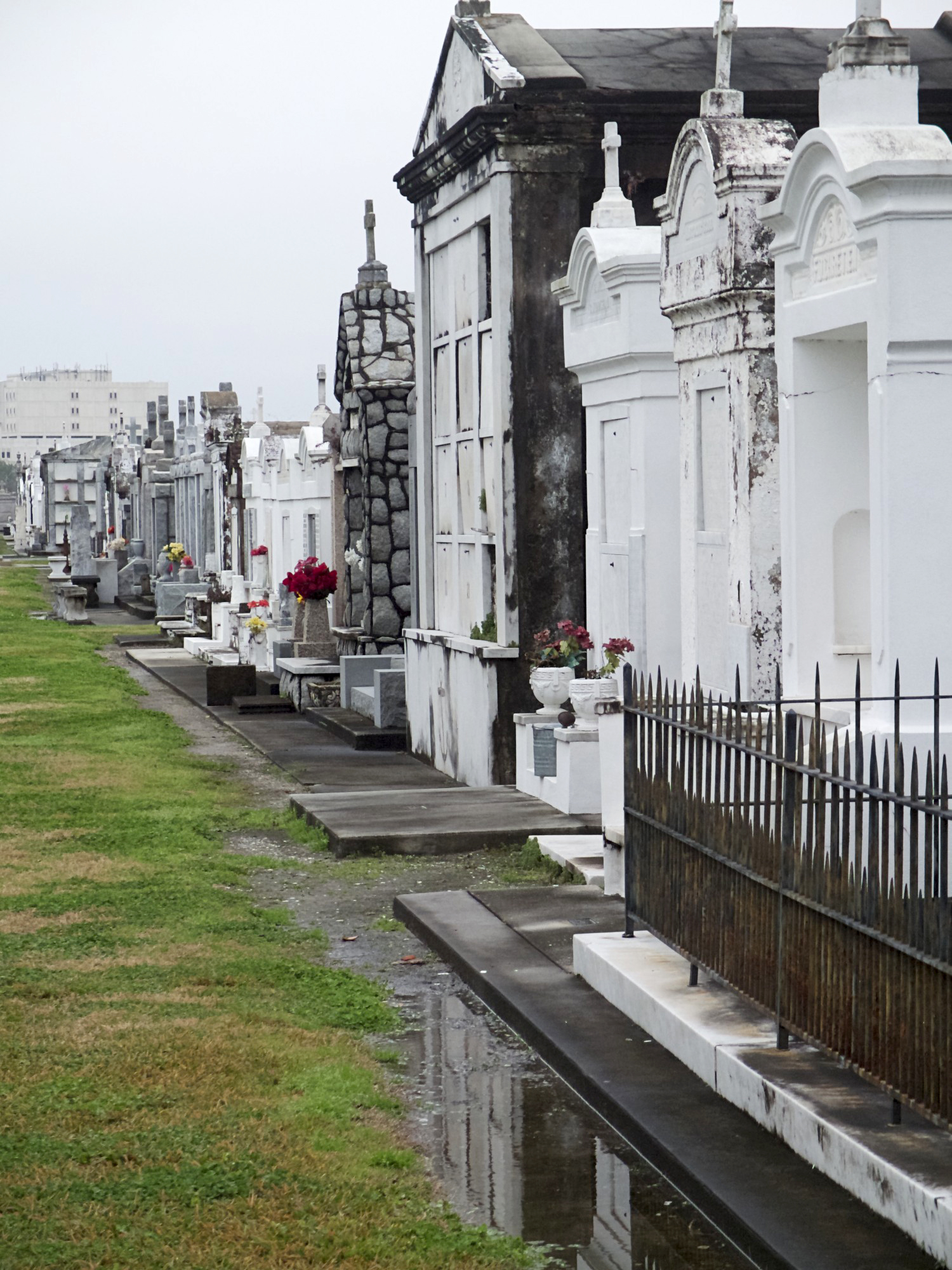
A grassy alley in Saint Louis No. 3. +
The Cities of the Dead were quite a surprise to me. I come from the northeastern land of sprawling cemeteries with headstone upon headstone marking below-ground burials. I’ve seen many mausoleums, yes, but they have a decidedly different feel than the tombs of NOLA’s cemeteries.
Above-ground tombs that house multiple members of families? At first, the thought made me shiver. But then, the more time I spent in the Cities of the Dead, the more the idea made sense to me — it became comforting.

Being with your family forever — a comforting thought. +
Recycling a burial space — all while keeping previous residents’ remains nearby — no longer feels “creepy” to me. Instead, it offers both practicality in avoiding the waterline and in a city short on space, as well as a strong feeling of the bond of family in both this life and the next.

A smaller family tomb. +
When it comes down to it, I think they’re doing death rites, well, right in New Orleans.
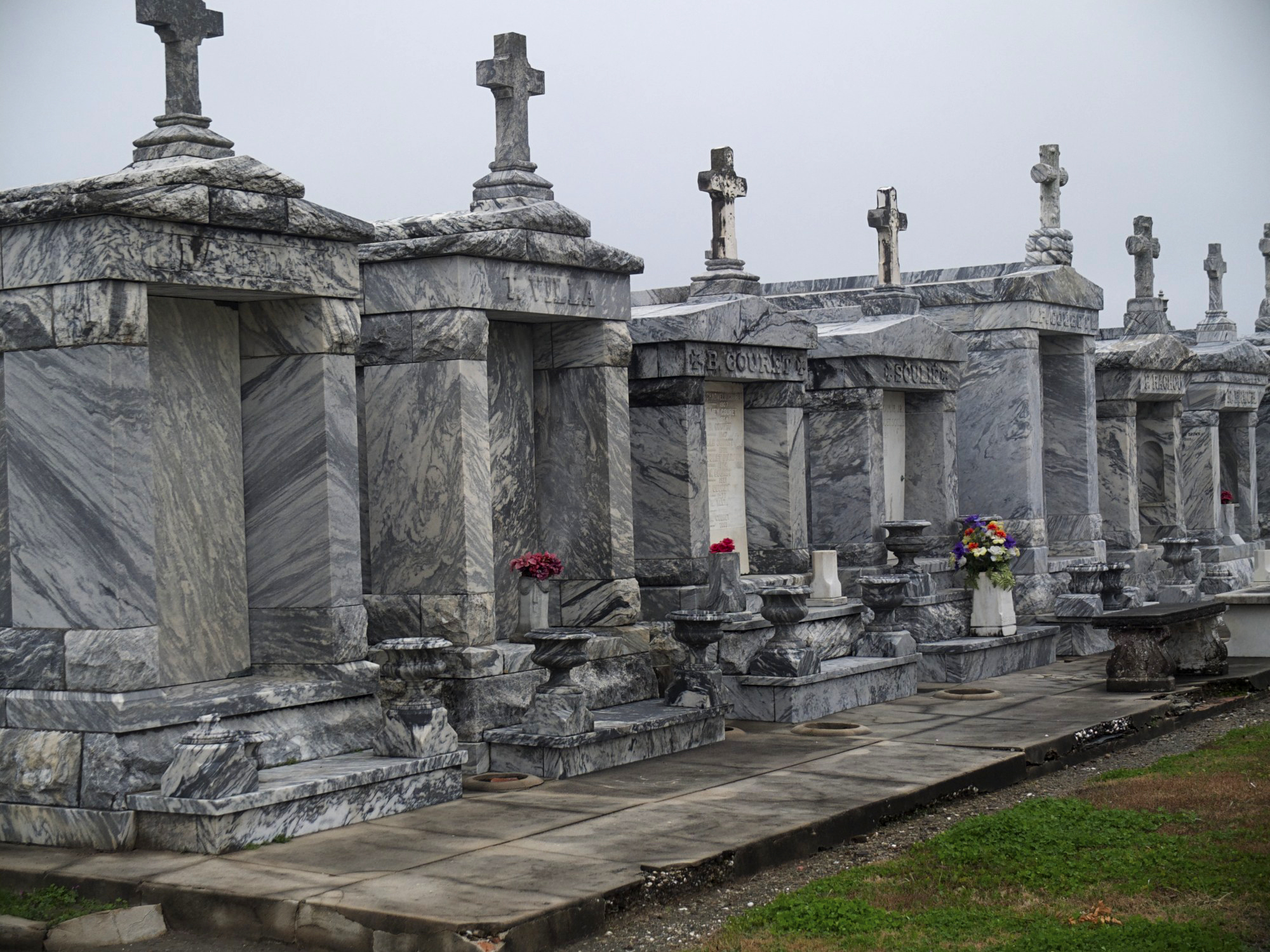
The Cities of the Dead are captivating — you should go. +
* denotes a photo taken in Saint Louis No. 1
+ denotes a photo taken in Saint Louis No. 3
 tiltandswing